taste of paris, 10th edition (part 2)
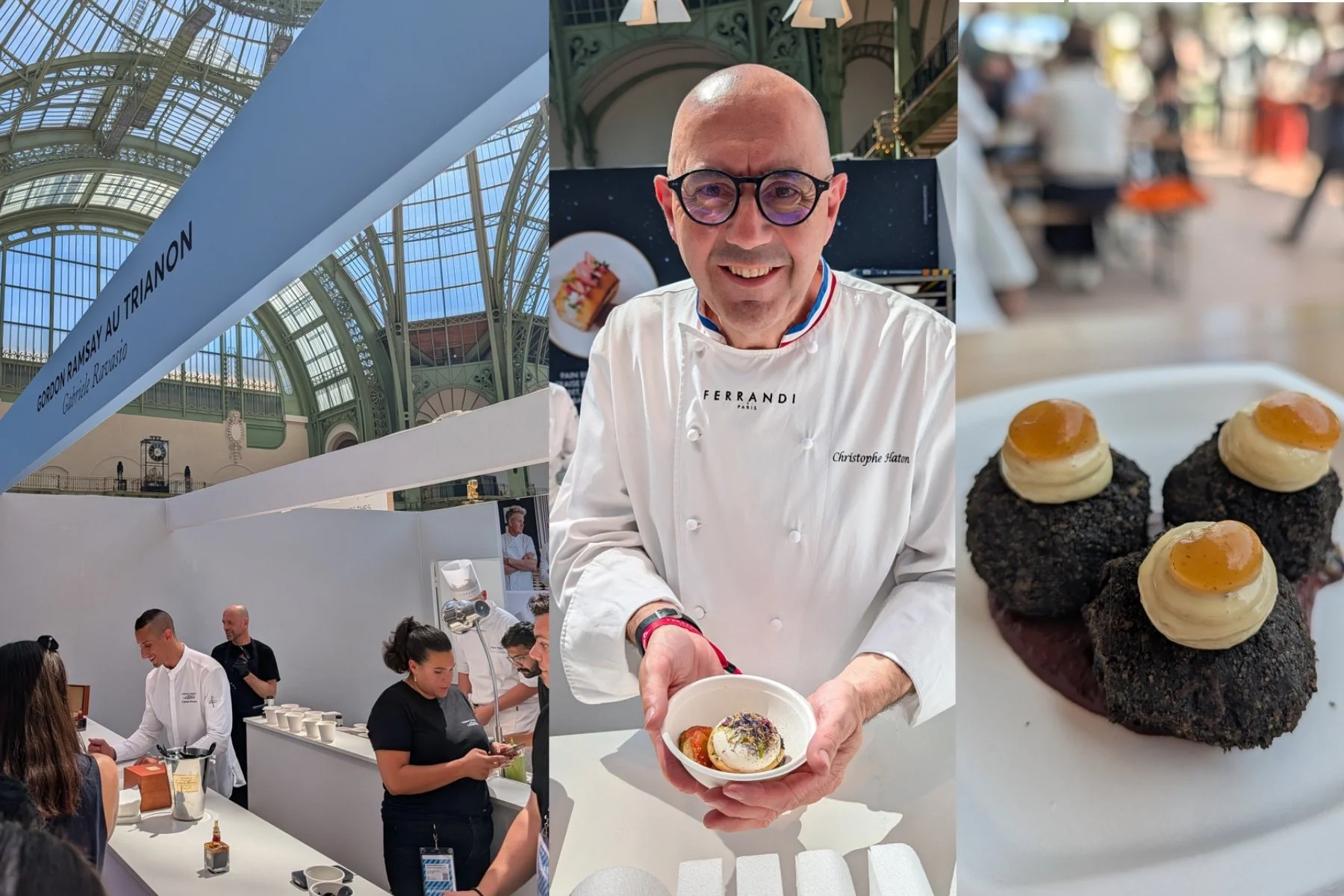
from left: Chef Gabriele Ravasio at the stand “Gordon Ramsey au Trianon”, Chef Christophe Haton at the stand of Ferrandi School holding the “Confit d’aubergine”, “Boules de Feu” LAVA by Wilfred Romain.
Christophe Haton: A Taste of Italy Through Ferrandi
Among the chefs present at Taste of Paris, Christophe Haton was perhaps the one who transported me most directly back to Italy.
The dish immediately caught the eye. Bright colours, edible flowers and careful plating gave it an elegant appearance without feeling overly decorative. Beneath the vegetables lay a generous layer of rocket pesto, while finely sliced rounds of vegetables rested on top. The true star of the dish, however, was hidden at its centre: a silky, almost buttery aubergine that revealed itself gradually with each bite.
Covering the composition was a savoury sablé topped with burrata cream. It shattered pleasantly under the fork, bringing notes of Parmesan and a subtle hint of sesame. The overall effect was distinctly Mediterranean, almost like a refined interpretation of a summer salad.
The sweetness of the confit tomato arrived first, followed by small bursts of citrus that cut through the richness of the burrata and kept the dish from becoming too indulgent. Every element had a clear purpose, creating a balance between freshness and comfort.
When I later met Chef Haton, recognisable by the tricolour collar of a Meilleur Ouvrier de France, I could not resist asking about the journey behind one of France's most respected culinary distinctions. He spoke of a long process requiring years of preparation, discipline and continuous refinement.
What stayed with me most, however, was not the title itself. Moments after our conversation ended, he was already back beside the Ferrandi students, helping them master the use of a siphon. It was a simple scene, but a telling one. The transmission of knowledge, perhaps more than any award, remains one of the defining marks of a true chef.
BOULES DE FOU, THE FLOOR IS (LITERALLY) LAVA
Three arancini arrived arranged on a bed of sauce and topped with two creams, one of them a striking yuzu. The dish certainly succeeded in attracting attention.
The tasting itself proved less convincing. The breadcrumb coating was darker and drier than expected, while the interior lacked the softness I usually expect from a well-executed arancino (or arancina, depending on wether one is in Palermo or Catania, Sicily) . The slightly bitter crust and pronounced smokiness immediately brought to mind certain American barbecue sauces and street-food flavours.
The most successful element was undoubtedly the yuzu cream. Combined with the persistent heat of the chilli, it created a sharp contrast that briefly seemed to electrify the palate which I found very interesting.
If the dish did not entirely win me over, the team's visual identity certainly deserves recognition. Giant drums, customised black t-shirts, loud music and constant movement made the stand impossible to ignore. LAVA embraced spectacle with confidence creating a memorable presence.
Final Thoughts
Overall, Taste of Paris offered a rare opportunity to experience high-level cuisine without the formality traditionally associated with fine dining.
The event reminded me of a moment that helped redefine Michelin dining for a wider audience: when Tim Ho Wan in Hong Kong demonstrated that exceptional cooking could exist beyond the confines of luxury restaurants. Taste of Paris follows a similar logic. Here, Michelin-starred cuisine steps out from behind closed doors and becomes accessible, visible and approachable.
The kitchens are fully exposed. Visitors can watch entire brigades at work, observing the rhythm, pressure and coordination required to produce hundreds of plates throughout the event.
Most importantly, the chefs themselves remain surprisingly accessible despite the crowds. Many were willing to stop, answer questions and engage with visitors, whether journalists, food enthusiasts or simply curious passers-by.
A final mention must go to the students of Ferrandi Paris (again, I know).
Like stage technicians working behind the scenes of a theatre production, they formed the invisible framework supporting the event. The chefs may have brought the names, the prestige and the menus, but much of the operation rested on the shoulders of these young aspiring cooks, moving quickly and precisely from station to station while continuing to chase their own ambitions.
Watching these young cooks move through the intensity of service, it was impossible not to wonder how many future great chefs were already among them. Their energy, discipline and determination left a lasting impression on me.
That spirit proved unexpectedly contagious. Inspired by what I witnessed there, at the 10th edition of Taste of Paris, I found myself wanting to create something of my own—not in the kitchen, but in the studio (expectional outdoor set up as you can see below): I am currently working on an oil painting that I intend to donate to the school, as a gesture of appreciation.
More than anything, I hope it serves as a reminder that their efforts do not go unnoticed. They are seen. Their talent, dedication and quiet resilience are recognised.
If Taste of Paris celebrates the achievements of today's chefs, Ferrandi's students offer a glimpse of those who may shape the future of French gastronomy. And I look forward to seeing it happen.
End part 2
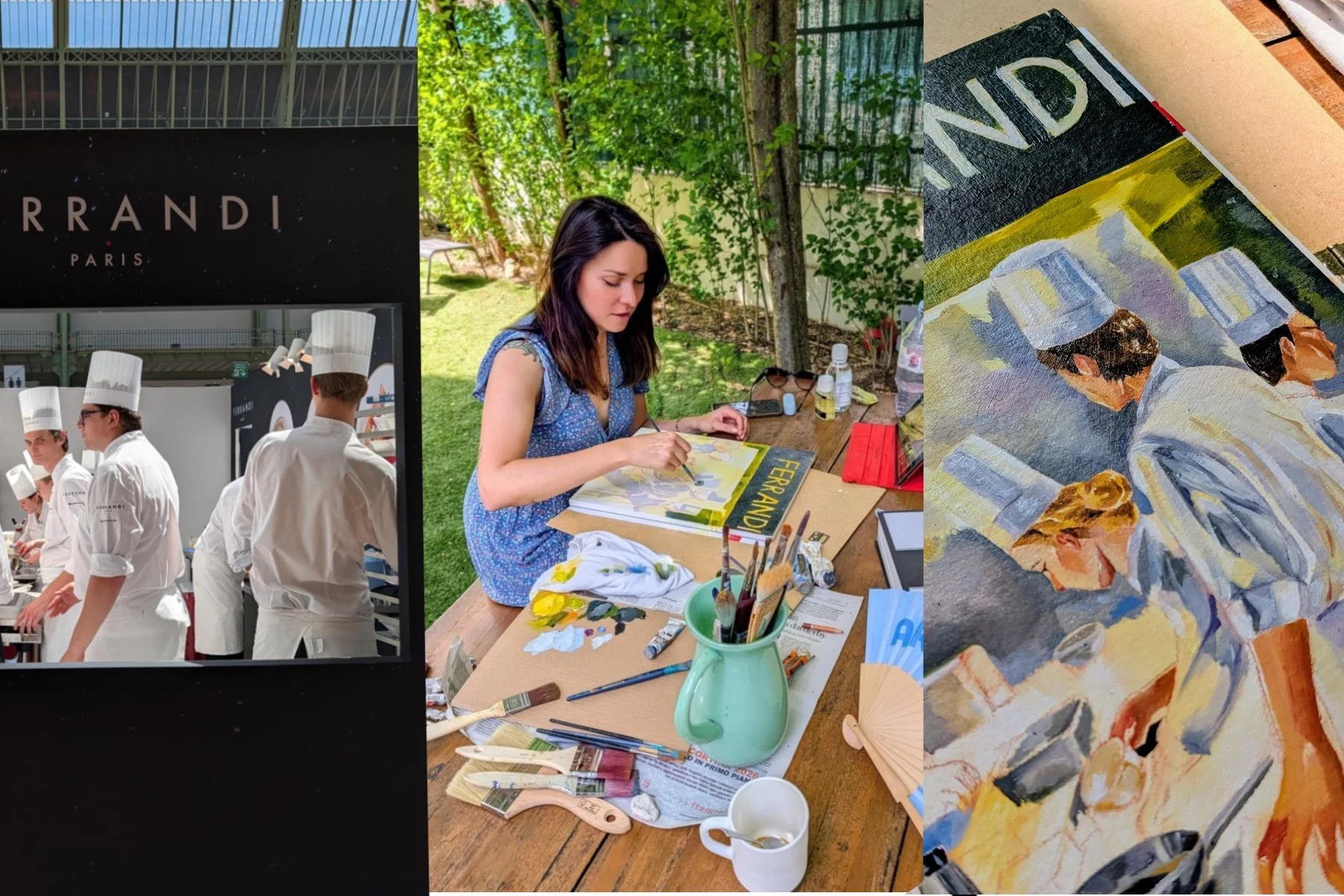
from left: Ferrandi students at work, the creation of the painting dedicated to the students, detail.
